


You built a great business. Your service is solid, your customers love you, and yet when someone nearby searches for exactly what you offer, your name is nowhere to be found.
Frustrating, right?
Here’s the thing: it’s rarely about the quality of your business. Most of the time, it comes down to one thing. You’re not using the right keywords.
Local SEO keywords are how Google figures out who you are, what you do, and where you do it. Get them right, and you start showing up in front of people in your area who are actively looking for what you sell. Get them wrong, and you’re basically invisible no matter how good your product or service is.
The good news? Finding the right keywords for local SEO isn’t rocket science. You don’t need a big marketing budget or an agency on speed dial. You just need the right process.
And that’s exactly what I’m going to walk you through today.
What Are Local SEO Keywords?
Local SEO keywords are search terms that include a specific location or a local intent. They help search engines connect your business to people searching in your area. Instead of competing with every business in the country, you’re only competing with the ones in your city or neighborhood.
Think of it this way. A bakery in Chicago targeting the keyword “best chocolate cake” is going up against millions of websites worldwide. But a bakery targeting “best chocolate cake in Chicago” or “custom cakes near Lincoln Park?” That’s a whole different ball game.
Why Local Keywords Matter for Small Businesses
Here’s a reality check. You’re not Amazon. You’re not a national chain with a million dollar marketing budget. And honestly? You don’t need to be.
Small businesses have one massive advantage over big brands. You’re local. And when someone in your city is ready to buy, they don’t want a company three states away. They want someone nearby, someone they can trust, someone they can walk into or call up.
That’s where local keywords come in.
When you use the right local keywords, you show up exactly when and where it matters most. Right in front of someone in your neighborhood who is already looking for what you offer. That’s not just traffic. That’s buying intent at its peak.
According to Google, 76% of people who search for something nearby on their smartphone visit a related business within a day. And 28% of those searches result in a purchase. Let that sink in for a second.
These are not random browsers. These are people with their wallets out.
And yet most small business owners skip local keyword research entirely. They either target keywords that are way too broad and get buried, or they target nothing specific at all and wonder why Google keeps ignoring them.
The businesses that show up at the top of local search results are not necessarily the best in town. They are just the ones that understood how to speak Google’s language. Local keywords are that language.
So if you want more calls, more walk-ins, and more customers who are actually close enough to buy from you, local keyword research is not optional. It’s the foundation everything else is built on.
Types of Local Search Keywords You Should Know
Before you start hunting for keywords, you need to understand what you’re hunting for. Not all local keywords work the same way. And using the wrong type in the wrong place can hurt more than it helps.
Here are the main types you need to know about.
1. Geo-modified or location-specific keywords
These are the most straightforward ones. You take your service and add a location to it. Simple as that.
“Electrician in Dallas.” “Wedding photographer in San Diego.” “Affordable accounting services in Miami.” The location is baked right into the search term, which means when someone types it in, they know exactly what they want and where they want it.
These are your bread and butter. Build your service pages and location pages around these and you’re already ahead of most of your competitors.
2. “Near me” keywords
You’ve typed these yourself. “Coffee shop near me.” “Urgent care near me.” “Dog groomer open near me.”
These searches have exploded over the last few years and a lot of these searches happens on Google Maps. Google searches for “near me” have grown by over 500% in recent years. And the best part? Google handles the location side automatically. You don’t need to rank for every city variation. You just need to make sure your Google Business Profile is set up properly and your website signals your location clearly.
3. Service Based Keywords
These focus purely on what you do, without a location attached. Think “roof repair,” “tax filing help,” or “personal trainer.” They carry local intent because Google often serves local results for these searches anyway, especially on mobile.
Don’t ignore these. They can drive serious traffic if your local SEO foundation is solid.
4. Neighborhood or Hyperlocal Keywords
Sometimes people don’t search by city. They search by neighborhood, district, or even landmark. “Restaurant near Times Square.” “Gym in South Beach.” “Lawyer in Downtown Seattle.”
If your business is in a well known neighborhood or district, these keywords can be a goldmine. Less competition, very specific intent, and customers who are practically around the corner.
5. “Best” and “Top” Keywords
People love social proof, even in their searches. “Best Italian restaurant in Boston.” “Top rated plumber in Denver.” “Best affordable dentist near me.”
These keywords signal that the searcher is in decision mode. They’re comparing options and getting ready to choose. Ranking for these puts you right in front of someone who is about to make a call or book an appointment.
Knowing these types isn’t just trivia. It shapes how you build your keyword list, how you structure your website, and where you focus your energy first.
Now that you know what to look for, let’s talk about how to actually find them.
How to do local SEO keyword research
Alright, this is the part you’ve been waiting for. Let’s get into the actual process. No fluff, just a step by step approach you can start using today.
1. Start with your core services
Before you touch a single keyword tool, grab a notebook or open a blank doc. Write down every single service you offer. Not the fancy marketing version. The plain, simple version your customers would actually use.
If you’re a plumber, that’s “drain cleaning,” “water heater repair,” “pipe leak fix.” If you run a salon, that’s “haircut,” “hair coloring,” “balayage.”
This list becomes your foundation. Every keyword you find later will branch out from these core terms. Skip this step and you’ll end up chasing random keywords that don’t actually match what you do.
2. Use Google autocomplete
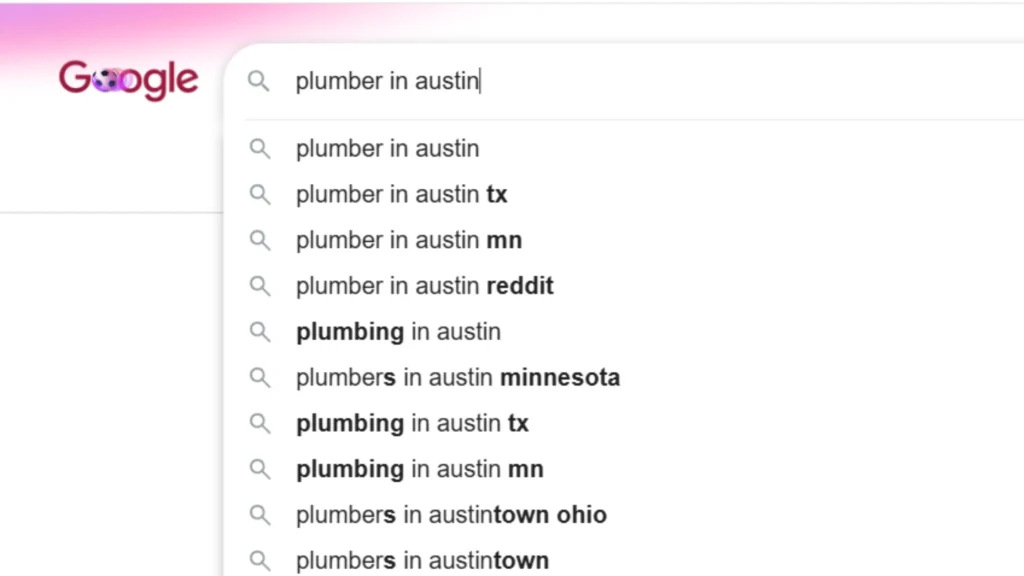
Here’s a free trick that takes thirty seconds. Open Google and start typing one of your core services followed by your city. Don’t hit enter. Just watch what pops up.
Type “plumber in Aus” and Google will instantly suggest “plumber in Austin,” “plumber in Austin TX open now,” and a handful of other variations real people are searching for right now.
This works because Google is showing you actual search behavior, not guesses. Do this for every service and every nearby location you serve. You’ll walk away with a solid list of long tail keywords in just a few minutes.
3. Check Google’s “people also ask” and related searches
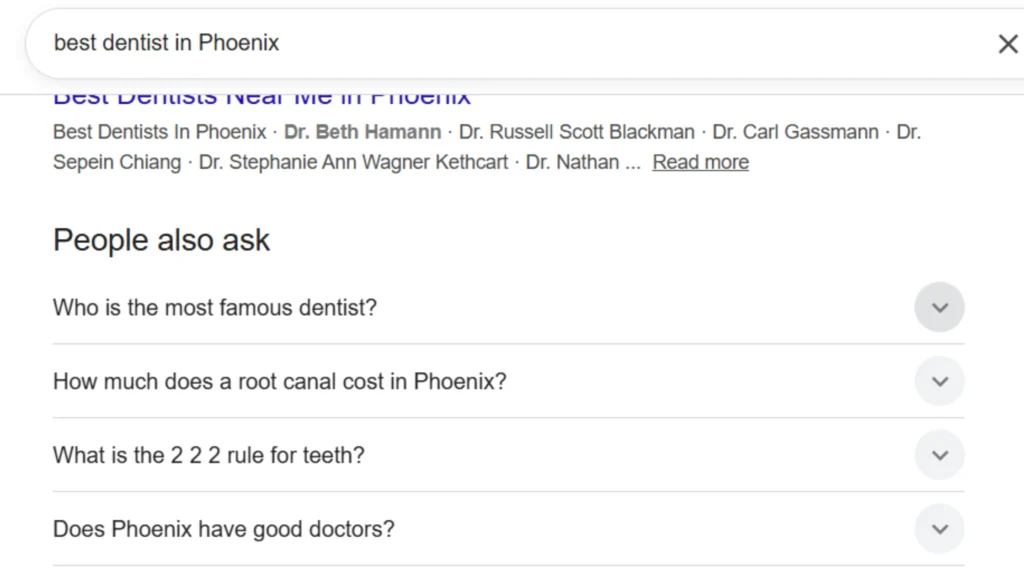
Now search your main keyword normally. Say, “best dentist in Phoenix.” Scroll down and you’ll spot two goldmines.
First, the “People Also Ask” box. These are real questions people are typing into Google around your topic. Things like “how much does a dentist visit cost in Phoenix” or “is there a dentist open on weekends near me.”
Second, scroll all the way to the bottom and check “related searches.” These are bonus keywords Google thinks are relevant to what you just searched.
Both sections are basically Google handing you keyword ideas for free. Use them.
4. Use tools like Google Keyword Planner, Semrush, Ahrefs etc.
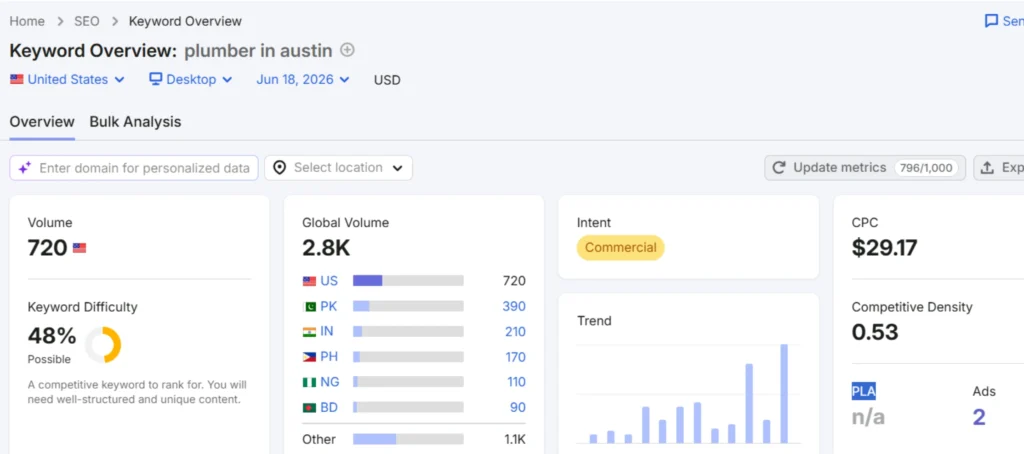
Manual research gets you far, but tools take it further by showing you actual search volume and competition data.
Google Keyword Planner is free and great for getting a baseline on how many people search for a term each month. Semrush gives you keyword suggestions along with estimated monthly search volume and keyword difficulty, which helps you figure out what’s actually realistic to rank for. Ahrefs goes even deeper if you want to dig into more advanced metrics.
Plug in your core services along with your city or neighborhood, and let the tool do the heavy lifting. You’re looking for keywords with decent search volume and low to medium competition. That’s your sweet spot.
5. Spy on Your Competitors’ Keywords
Want a shortcut? Look at what’s already working for your competitors.
Search for your main keywords and check out the businesses ranking on page one. Visit their websites. Look at their page titles, headers, and the words they repeat throughout their content.
You can also plug their website URL into Semrush or Ahrefs to see exactly which keywords are sending them traffic. If a competitor down the street is ranking for “emergency locksmith in Denver” and you’re not, that’s a clear gap you can go after.
This isn’t copying. It’s just smart research or called competitor analysis. They’ve already done some of the guesswork for you.
6. Mine your Google Business Profile insights
Here’s one most business owners completely overlook. Your Google Business Profile (Earlier Google My Business – GMB) dashboard quietly collects valuable data about how people are finding you.
Head over to your profile and check the “Insights” or “Performance” section. You’ll see the exact search terms people used before they found your listing. This is gold because it’s not estimated data. It’s real searches from real people who found your actual business.
Use these terms to refine your website content, your service pages, and even future Google posts. If you notice people searching “24 hour vet near me” and that’s something you offer, make sure that phrase shows up clearly on your site.
Put all six of these methods together and you won’t just have a handful of keywords. You’ll have a complete, real world picture of how your exact customers are searching for what you offer.
Conclusion
Local SEO keyword research isn’t some complicated technical skill reserved for big agencies. It’s something any small business owner can do with a notebook, a few free tools, and an hour of focused time.
Start with what you know. Your services, your location, your customers. Then layer on Google Autocomplete, “People Also Ask,” keyword tools, competitor research, and your own Google Business Profile insights. Before long, you’ll have a list of keywords that actually reflect how real people search for businesses like yours.
The businesses winning at local SEO aren’t necessarily better than you. They just took the time to speak Google’s language and show up where it counts.
That said, if all of this feels like a lot to juggle on top of actually running your business, you don’t have to do it alone. At SwiftRankers, we specialize in local SEO and can handle the keyword research, optimization, and everything in between, so you can focus on what you do best. Book a discovery call with us today and let’s get your business showing up exactly where your customers are searching.
