


If you’re a chiropractor and your phone isn’t ringing as much as you’d like, there’s a good chance your SEO is the problem. Not your skills. Not your location. Not your prices. Your SEO.
Studies show that over 77% of patients search online before booking a healthcare appointment. If you’re not showing up when they search, you simply don’t exist to them. The good news? That’s completely fixable. And this guide will show you exactly how.
Why Should Chiropractors Invest in SEO?
Think about what happens when someone in your city wakes up with chronic back pain and decides to finally do something about it. They don’t flip through a directory. They don’t ask around the office. They pick up their phone and search.
If your practice shows up right there, you’ve just earned a potential patient who came to you already looking for help. That’s what SEO does. It increases your visibility at the exact moment someone is actively searching for chiropractic services, which means the people landing on your website aren’t cold leads. They’re warm ones.
But the real power of SEO goes beyond just getting found. Unlike paid advertising where your visibility lives and dies with your budget, SEO builds something permanent. Every improvement you make to your website, every piece of helpful content you publish, every local listing you optimize compounds over time.
Six months from now, a year from now, that work is still pulling patients in. And as your rankings climb, something else happens quietly in the background. Your credibility grows. Patients trust practices that show up consistently at the top of Google. SEO puts you there and keeps you there.
1. Start With an SEO Audit of Your Chiropractic Website
You wouldn’t treat a patient without understanding what’s wrong first. Your website deserves the same approach. An SEO audit is your starting point and honestly one of the most valuable things you can do for your practice’s online visibility. It shows you exactly why your website isn’t ranking where it should and gives you a clear roadmap for fixing it.
What does a good audit cover? Everything. How fast your pages load. Whether your site works properly on mobile. If Google can actually crawl and index your content. Whether your title tags and meta descriptions are optimized.
How your backlink profile looks compared to competing practices in your area. Each of these factors plays a role in where you show up in search results. Fix the ones that are broken and you’ll often see improvements in your rankings before you’ve even touched your content strategy. An audit isn’t the most glamorous part of SEO. But skipping it is one of the most expensive mistakes a chiropractic practice can make.
2. Find the Right Keywords Potential Patients Are Searching For
If you’re targeting the wrong keywords the rest of your SEO doesn’t matter. You could have the best chiropractic website in the world and still get zero new patients if you’re showing up for searches nobody relevant is making. This is where most chiropractic SEO quietly falls apart. Effective local keyword research helps you identify the keywords that actually bring qualified patients to your practice, such as:
Target Condition-Based Keywords
Think like your patient, not like a chiropractor. The people you want to reach aren’t searching for clinical terminology. They’re searching for the problem keeping them up at night. “Chronic back pain relief,” “pinched nerve treatment,” “chiropractor for whiplash.” These condition based keywords are where the real patient volume lives.
Tools like Google Keyword Planner, Ahrefs or SEMrush can help you find exactly which conditions your local audience is searching for most. Build your service pages and content around those terms and you’ll start attracting people who already need what you offer.
Target Location-Based Keywords
A chiropractor in Denver isn’t competing with one in Miami. Your SEO should reflect that. Location based keywords narrow your visibility down to the people who can actually become your patients, the ones searching within driving distance of your practice.
Go beyond just your city name too. Target specific suburbs, zip codes and even landmarks near your practice. “Chiropractor near [landmark]” or “back pain specialist in [suburb]” are the kinds of searches that bring in highly local, highly relevant traffic.
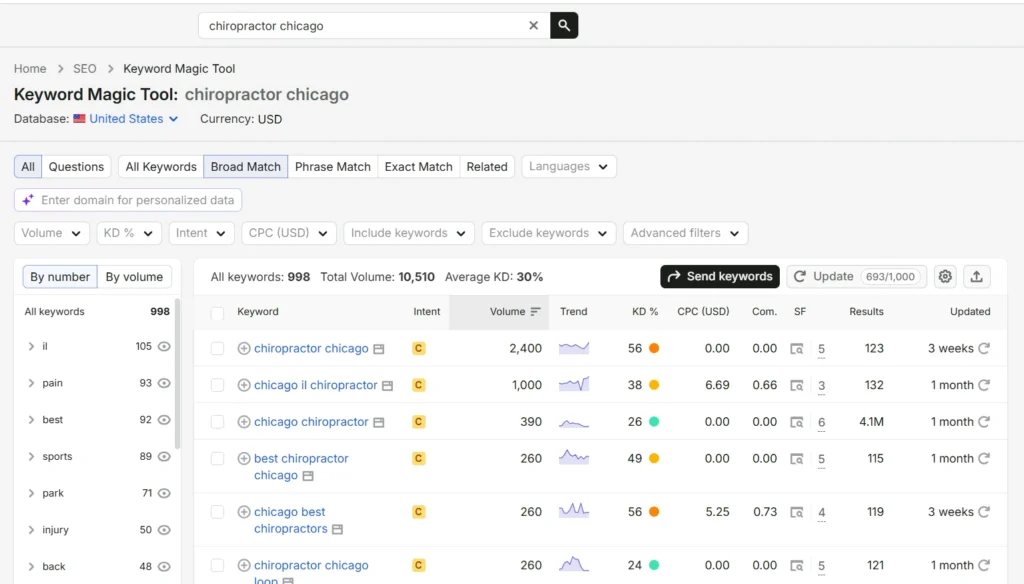
Understand Search Intent Before Choosing Keywords
A keyword with ten thousand monthly searches means nothing if the people searching it aren’t looking for a chiropractor. Search intent is what separates keywords that bring traffic from keywords that bring patients. Always ask why someone is searching before you decide to target a term.
Informational searches like “how does chiropractic work” attract curious browsers. Transactional searches like “chiropractor near me” attract people ready to act. Build your strategy around the second type and your rankings will start translating into real appointments, not just website visits.
3. Optimize Your Google Business Profile for Local Visibility
If there’s one thing that will move the needle fastest for a chiropractic practice it’s a fully optimized Google Business Profile. This is what shows up when someone searches “chiropractor near me” and it’s often the very first impression a potential patient gets of your practice. Most chiropractors set it up once and never touch it again. That’s a mistake.
Choose the Most Relevant Primary and Secondary Categories
Your primary category should be “Chiropractor” but don’t stop there. Secondary categories help Google understand everything your practice offers and expand the searches your profile can appear in. Sports injury treatment, rehabilitation services, massage therapy. Add every category that genuinely applies to your practice and watch your local visibility grow.
Complete All Business Information
An incomplete Google Business Profile is a missed opportunity plain and simple. Fill in every single field Google gives you. Your website, phone number, address, opening hours, attributes and anything else available. Google rewards complete profiles with better visibility and patients trust them more.
Add Chiropractic Services
Google lets you list your individual services directly on your profile. Use this feature. Add every treatment you offer, from spinal adjustments and sports injury care to posture correction and massage therapy, along with a brief description and price range where possible. It helps both Google and potential patients understand exactly what you do.
Write an Optimized Business Description
Your business description is prime real estate and most chiropractors waste it. Write a clear, compelling description that tells potential patients who you are, what conditions you treat and why your practice is the right choice for them. Naturally include keywords like “chiropractor in [city]” and the conditions you specialize in without making it feel forced.
Upload High Quality Photos Regularly
Profiles with photos get significantly more clicks than those without. Patients want to see your practice before they book and photos answer that question instantly. Upload images of your reception area, treatment rooms, equipment and your team. And keep adding new ones regularly because Google notices fresh activity and rewards it.
Publish Google Posts Regularly
Most chiropractors have never published a single Google Post. That’s a competitive advantage sitting there waiting for you. Use posts to share practice updates, seasonal health tips, special offers or new services. They show up directly on your profile in search results and signal to Google that your practice is active and engaged.
Keep Business Hours Accurate
Nothing frustrates a potential patient more than showing up to a practice that’s closed when Google said it was open. Keep your hours updated at all times including holidays and special closures. Inaccurate hours don’t just lose you patients. They damage the trust your profile works hard to build.
Answer Questions in the Q&A Section
The Q&A section on your Google Business Profile is one of the most overlooked features in local SEO. Patients ask questions there and if you don’t answer them someone else might, and not always accurately. Check your Q&A section regularly, answer every question promptly and even seed it with your own frequently asked questions and answers to get ahead of what patients want to know.
Most Importantly, Keep Your NAP Consistent
NAP consistency might sound like a minor detail but it’s one Google takes seriously. Your practice name, address and phone number need to be identical across your Google Business Profile, your website and every directory you’re listed on. Discrepancies confuse search engines and erode the local trust signals your profile depends on.
4. Improve Your Website’s Technical SEO
Most chiropractors pour energy into content and completely ignore the technical side of their website. That’s a costly mistake. Technical SEO is what makes sure Google can actually find, crawl and rank your pages properly and without it everything else you do falls short.
Improve Page Speed
A slow website is a patient repellent. Studies show that even a one second delay in load time can significantly hurt your conversions. Run your site through Google PageSpeed Insights, find the biggest speed issues and fix them one by one.
Make Your Website Mobile Friendly
Pull out your phone right now and visit your own website. If it feels clunky or hard to navigate you’re losing patients every single day. Google prioritizes mobile friendly websites in its rankings and the majority of local searches happen on mobile devices.
Here’s a pro tip: you can use MS Clarity tool which provides you with session recording and heatmaps. By analyzing them, you can identify if there’s anything that’s hurting user experience and leading to poor conversion rate.
Fix Broken Links and Crawl Errors
Every broken link on your website is a dead end for both visitors and search engines. Google Search Console shows you exactly which pages are throwing errors and which links are going nowhere. Fix them regularly and your site becomes cleaner and easier for Google to rank confidently.
5. Create Dedicated Pages for Every Chiropractic Service
If someone searches “chiropractor for sciatica in [city]” and you don’t have a dedicated page for sciatica treatment your chances of ranking for that search are almost zero. Search engines want to send people to the most relevant specific page available and a generic services page simply can’t compete. Every treatment you offer deserves its own page, its own keyword focus and its own optimized content.
Write each page for the patient first and Google second. Address their pain point directly, explain what the treatment involves and make it easy for them to take the next step. The more genuinely helpful your service pages are the better they tend to rank. Google has gotten very good at telling the difference.
6. Optimize Your Website for Local SEO
Local SEO optimizes your website specifically for those searches and it goes well beyond just mentioning your city name a few times. Here’s exactly what needs to be in place.
- Include location information naturally: Your city and surrounding areas should appear throughout your website content in a way that reads naturally. Think “back pain treatment in [city]” worked into a paragraph rather than a list of locations stuffed into a footer.
- Optimize title tags and meta descriptions: These are the first things a potential patient sees in search results. Make them count. Include your target keyword, your location and a compelling reason to click. Every page deserves its own unique version.
- Add location details to service pages where relevant: Your service pages shouldn’t just describe what you do. They should tell Google and patients where you do it. A simple location reference woven naturally into each service page builds powerful local relevance across your entire site.
- Embed a map on your contact or location page: A Google Maps embed isn’t just helpful for patients finding your clinic. It’s a local SEO signal that confirms your physical location to search engines. Add it to your contact page and keep your address information directly alongside it.
- Create individual location pages for multi location practices: Each practice location needs its own dedicated page with unique content, its own NAP information and its own local keyword focus. Lumping multiple locations onto one page splits your local relevance and hurts every location’s ability to rank. If your practice operates across multiple locations our complete guide to local SEO for multiple locations walks you through exactly how to set this up the right way.
7. Create Helpful Content Around Patients’ Questions and Concerns
Google’s entire job is to match searchers with the most helpful, relevant content available. The chiropractic practices that understand this and create content that genuinely answers patient questions are the ones quietly dominating local search results. It’s not about publishing as much content as possible. It’s about publishing the right content for the right audience at the right moment in their journey.
Find Topics Based on the Patient Journey
A patient’s journey to your clinic usually starts long before they’re ready to book. They’re searching for answers about their symptoms, researching treatment options and looking for reassurance before they commit. Create content for every stage of that journey, from “what causes lower back pain” to “what to expect at your first chiropractic appointment,” and you’ll be building trust with potential patients well before they ever land on your service pages.
Answer Common Questions Potential Patients Ask
The questions your front desk gets asked every day are your best content ideas. “Is chiropractic safe?” “How many sessions will I need?” “Can a chiropractor help with headaches?” Every question a patient asks in your clinic is a question someone else is typing into Google right now. Answer them thoroughly and honestly and you’ll attract exactly the kind of engaged, informed patients who are most likely to book.
Create Content Around Symptoms and Conditions
Most patients don’t start their search with “chiropractor.” They start with their symptom. “Why does my lower back hurt?” “What causes neck stiffness?” “How do I relieve sciatica pain?” Creating dedicated content around the symptoms and conditions you treat connects you with patients at the very beginning of their search journey, before they’ve even decided what kind of help they need.
Build Topic Clusters Around Your Core Chiropractic Services
A topic cluster is a group of related content pieces that all link back to a central service page. For example your spinal adjustment service page becomes the hub and blog posts like “5 signs you need a spinal adjustment” or “spinal adjustment vs massage therapy” become the supporting content. This structure signals to Google that your website has deep expertise in these areas and consistently boosts rankings across the entire cluster.
Update Existing Content Regularly
Publishing content and never touching it again is a missed opportunity. Google and Generative AI models like ChatGPT, Gemini, Claude etc. favor fresh, updated content and older posts that get refreshed with new information, better examples and updated keywords often see significant ranking improvements without starting from scratch. Set a schedule to revisit your top performing content every six to twelve months and keep it as helpful and current as possible.
9. Demonstrate Experience, Expertise, and Trust
In healthcare trust is the deciding factor. A potential patient choosing between two chiropractic practices will go with the one that feels more credible every single time. Your website is where that trust is either built or lost.
Put your qualifications, experience and real patient outcomes front and center. Detailed team bios, genuine testimonials and content written from actual clinical expertise are what Google looks for under its E-E-A-T guidelines. Get these right and both your rankings and your booking rate will show it.
10. Get More Patient Reviews and Manage Your Online Reputation
Reviews are not just social proof. They are a direct local ranking factor that Google uses to decide which chiropractic practices deserve to show up first in search results. More reviews, higher ratings and consistent responses all signal to Google that your practice is active, trusted and worth recommending to searchers.
Build a simple system for collecting reviews and stick to it. A follow up message after each appointment with a direct link takes thirty seconds to send and dramatically increases the number of patients who actually leave one. Never ignore a negative review either. A calm, professional response shows potential patients that you take feedback seriously and that you genuinely care about every patient experience.
11. Off-Site SEO for Your Chiropractic Website
Your SEO doesn’t stop at your website. What happens off your website matters just as much to Google as what’s on it. Off site SEO is how you build the kind of authority and trust that tells search engines your chiropractic practice is the real deal, not just another website claiming to be.
Build Local Citations and Keep Your Business Information Consistent
A local citation is any mention of your practice name, address and phone number on another website. Directories like Yelp, Healthgrades, Zocdoc and local business listings all count. The more consistent and widespread these citations are the more confident Google becomes about recommending your practice to local searchers.
Inconsistencies across these listings quietly kill your local rankings. A slightly different phone number here, an old address there. It adds up. Audit your citations regularly using tools like BrightLocal or Moz Local and make sure every mention of your practice is identical everywhere it appears.
Earn High Quality Backlinks
A backlink is when another website links to yours. Google treats these like votes of confidence and the more credible the website linking to you the more that vote is worth. A single link from a respected local health publication or medical directory does more for your rankings than dozens of links from low quality sites.
Earning backlinks takes effort but it’s worth it. Write guest posts for health blogs, get listed in online directories (mainly for medical practices), sponsor local community events and reach out to local press when you have something newsworthy to share. Every quality link you earn makes your website more authoritative and harder for competitors to outrank.
12. Add Relevant Schema Markup
Ever noticed how some search results show star ratings, business hours or frequently asked questions directly in Google without you having to click anything? That’s schema markup at work. It’s a behind the scenes code addition that feeds Google structured information about your practice and gets rewarded with richer more eye catching search results.
For chiropractors the most important schema types to implement are LocalBusiness, MedicalBusiness, Review and FAQ schema. These tell Google precisely who you are, where you are, what patients think of you and what questions your content answers. More visibility in search results means more clicks and more clicks means more patients finding their way to your practice.
13. Optimize the Website to Turn SEO Traffic Into Patient Enquiries
Here’s a question most chiropractors never ask. Of all the people visiting my website this month how many new patient appointments are coming in? If you don’t know that number you’re flying blind. SEO without conversion optimization is like filling a waiting room with chairs that nobody wants to sit in.
Your website needs to do more than inform. It needs to persuade. Every page should be built with one goal in mind, turning a curious visitor into a patient enquiry. That means clear calls to action above the fold, a phone number visible at all times, a booking process that takes seconds not minutes and trust signals like reviews and credentials that reassure a hesitant visitor right when they need it most.
Don’t overlook the match between your SEO traffic and your landing pages either. If someone searches “chiropractor for neck pain” and lands on your homepage they have to do extra work to find what they came for. Most won’t bother. Build focused landing pages that speak directly to what the visitor searched for and your conversion rate will improve almost immediately.
14. Track Your Chiropractic SEO Performance
If you can’t measure it you can’t improve it. That’s true in chiropractic care and it’s just as true in SEO. Tracking your SEO performance isn’t just about knowing your rankings. It’s about understanding what’s driving real patient enquiries and doubling down on what works.
Google Analytics shows you where your traffic is coming from, how visitors behave on your website and which pages are doing the heavy lifting in terms of conversions.
Google Search Console tells you which search terms are bringing people to your site and flags any technical issues that might be holding your rankings back.
Together they give you everything you need to make smart informed decisions about your SEO strategy.
Set a regular schedule for reviewing your performance data. Monthly at a minimum, weekly if you’re actively growing. Look at your organic traffic trends, your keyword rankings, your bounce rate and your conversion numbers. SEO is a long game but the practices that track consistently are always the ones that end up winning it.
Common Chiropractic SEO Mistakes to Avoid
SEO mistakes are expensive. Not always immediately but over time they compound into lost rankings, wasted budgets and patients who found your competitor instead of you. Here are the most common ones we see chiropractic practices make and exactly why they matter.
- Targeting only broad keywords: Broad keywords attract everyone and convert almost nobody. “Chiropractor” might get millions of searches but ranking for it is nearly impossible for a local practice. Go specific, go local and go after the searches that come with real booking intent behind them.
- Creating thin or generic AI generated content: Publishing content that covers a topic superficially without any real depth or clinical insight is one of the fastest ways to lose Google’s trust. Patients can tell when content was written by nobody in particular and so can Google.
- Having one page for all services: Cramming every service onto one page splits your relevance and weakens your ability to rank for any of them. Create individual pages for each service and give Google a clear, focused signal for every treatment you offer.
- Ignoring Google Business Profile optimization: In local SEO your Google Business Profile is arguably more important than your website. An incomplete or neglected profile means missed rankings in the map pack and missed patients who never even make it to your website.
- Keyword stuffing: Forcing your target keyword into every paragraph doesn’t fool Google anymore. It reads as unnatural, hurts your user experience and can actively suppress your rankings. Write for people first and let keywords fall in naturally.
- Buying low quality backlinks: A hundred links from low quality websites do far more damage than good. Google sees right through manipulative link schemes and the penalties that come with them can take months or years to recover from. Earn links the right way or don’t bother.
- Neglecting technical SEO: Great content on a technically broken website is like a beautifully designed clinic that patients can’t find the entrance to. Page speed, mobile friendliness, crawlability and site structure all need to be in order before anything else you do in SEO will perform as it should.
- Focusing on traffic instead of patient enquiries: High traffic numbers feel good until you realize none of those visitors are booking appointments. Optimize for the actions that matter, calls, form submissions and bookings, not just the volume of people landing on your pages.
- Failing to track calls and conversions: Without proper tracking you’re making SEO decisions based on guesswork. Set up Google Analytics, use call tracking software and monitor your conversions consistently. The data will tell you exactly where to focus your efforts and what to stop wasting time on.
How Long Does SEO Take to Work for Chiropractors?
There’s no sugarcoating this. SEO takes time. Anyone promising you page one rankings in thirty days is either lying or about to get your website penalized. Real sustainable SEO that consistently drives new patients to your practice takes three to twelve months depending on your starting point and how competitive your local market is.
What makes that timeline worth committing to is the compounding return. Unlike paid advertising where visibility evaporates the moment your budget runs out, every month of SEO work builds on the last. The practices that stay consistent are the ones that eventually own their local search results and stay there.
Conclusion
If there’s one thing to take away from this guide it’s this. Your patients are searching online every single day for exactly what you offer. The only question is whether they’re finding you or the practice down the road. SEO is what tips that balance in your favor and keeps it there.
You don’t have to do everything at once. Start with the foundations, build momentum and keep going. The chiropractors who commit to SEO don’t just rank better. They build practices that are genuinely harder to compete with.
Want to fast track that growth with a team that specializes in exactly this? Explore our Chiropractor SEO Services and let’s start building the kind of online presence that fills your appointment book.
